Is Rx Kids About Helping Families, Increasing Voter Turnout or Both?
Critics point to new research linking the cash aid initiative to civic participation, while supporters say the findings reflect community stability, not politics.
LANSING, Mich. — A Michigan program that gives cash payments to new and expectant mothers is facing renewed political scrutiny after newly released research suggested a connection between the initiative and increased civic participation, including voting.
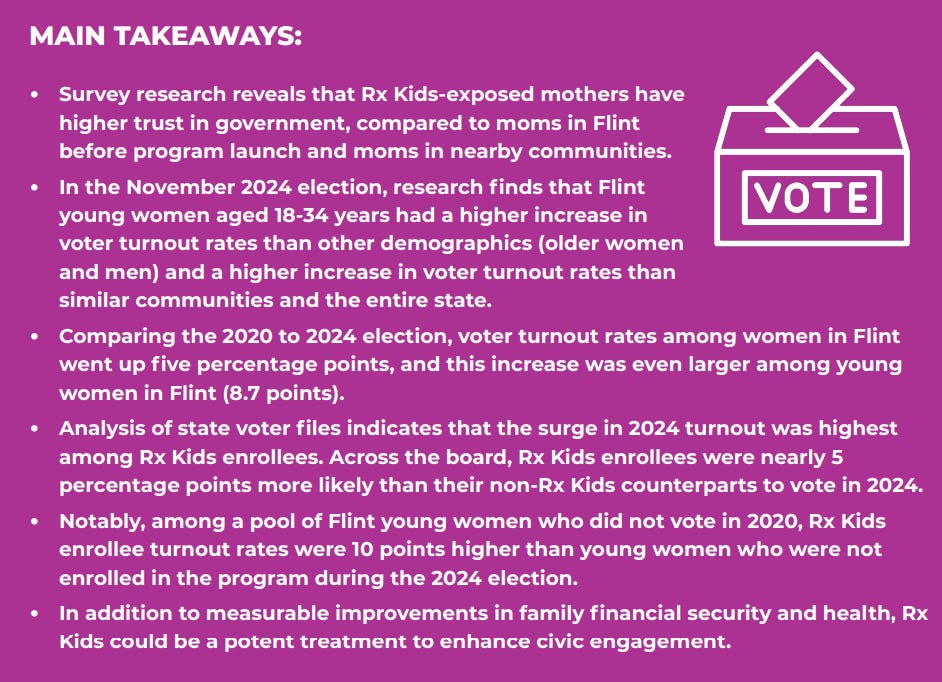
The graphic below is from RxKids.
The program, known as Rx Kids, provides direct cash support to pregnant women and families with infants during a child’s early months. Supporters describe it as a public health initiative designed to improve birth outcomes, reduce poverty stress and support early childhood development.
The program launched in Flint and has drawn national attention as one of the first guaranteed income programs in the country focused specifically on maternal and infant health.
A research brief published by the program’s partners reported an association between participation in Rx Kids and higher levels of civic engagement. The document states that recipients showed increased likelihood of activities such as registering to vote, voting in elections and participating in community activities. Researchers described civic participation as one indicator of improved stability and well being.
A separate release from Michigan State University highlighted similar findings, saying program participants reported stronger community involvement and greater trust in institutions compared with non participants.
Critics argue the inclusion of voting data raises concerns about whether public funds are being used in ways that intersect with political outcomes. State Sen. Lana Theis said the research emphasis is troubling.
“Voter turnout is not a public health metric. Public health tax dollars are spent to solve health problems, not to shape elections. When that distinction fades, it is a serious red flag,” Theis said in a statement.
Support my independent journalist if you aren’t already by becoming a paid subscriber for less than $1 per week. I rely on your support to continue this work.
Michigan House Speaker Matt Hall has also criticized the program, calling it fiscally irresponsible and questioning whether the state should continue funding it. He said lawmakers should focus spending on core services rather than expanding direct cash programs.
Supporters of Rx Kids reject claims that the program is political. Organizers say the research does not attempt to influence voting behavior but instead measures whether financial stability allows families to engage more fully in their communities. They say civic participation is a widely used social science indicator tied to long term health and economic outcomes.
Program leaders emphasize that funds are distributed with no requirement related to voting, political activity or ideology. Payments are unconditional and available to qualifying families regardless of party affiliation or voting history.
Policy analysts note that guaranteed income programs nationwide are often studied for secondary effects beyond finances, including mental health, education outcomes and social participation. Still, the Michigan debate reflects a broader national dispute about whether government cash assistance programs should be evaluated partly through civic engagement metrics.
The controversy comes as lawmakers weigh future funding decisions that could determine whether Rx Kids expands to additional communities or remains limited to pilot locations.
For now, the research has placed the program at the center of a policy debate that extends beyond public health and into questions about the role government initiatives should play in civic life.


Is this the same one they are questioning because it is paying $619,000 for publicity? The one that takes administrative fees and then passes it to a third party for distribution and the third party also takes administrative fees? This program needs to go. They have no way of knowing this cash is used for the children. Who's accountable? No one that I can see.